.png)
FISH FEEDING SANCTUARY NT


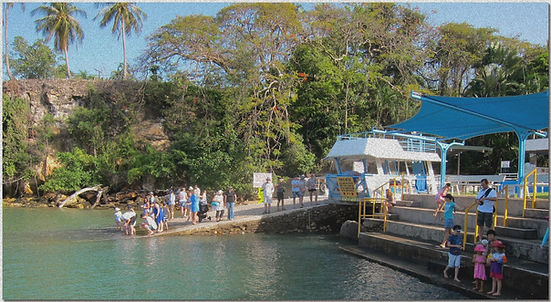
Discovery of the Shou Lao
In 1879 a team of road workers removing a large Banyan tree halfway up the hill from Doctors Gully made a discovery that would raise extraordinary questions about Australia's pre-colonial history.
Buried beneath the roots of the tree was a small Asian statuette. It wasn't until 1928 that it was positively identified as an image of Shou Lao — the Taoist immortal and God of Longevity. Historians believe early Chinese sailors deliberately placed the statuette beneath the Banyan tree as a sacrificial offering, a gesture deeply rooted in Chinese spiritual tradition.
The Banyan tree itself is thought to hold Chinese cultural significance, and its dense root system preserved the statuette across centuries underground.
The discovery sparked compelling theories connecting the Shou Lao to the voyages of legendary Chinese Admiral Cheng Ho, who may have visited Darwin's shores between 1405 and 1433 — either blown off course or taking a detour from Timor, where his fleet was known to have searched for riches, timber and spices.
Evidence suggests Chinese seafarers may have landed at Doctors Gully as early as the 5th century, using it as a base to mine gold, silver and tin as far inland as Kakadu.
Today the Shou Lao statuette is on permanent display at the Powerhouse Museum in Sydney, where it has been since 1950 — a remarkable relic of Darwin's ancient connection to China.
